Sleep for peak health: In conversation with Marcello Ferri
An expert insight series for Sleep Awareness Month 2026, exploring the science and optimisation of sleep for improved health and vitality
Wellness expert and biohacker Marcello Ferri joins our continued series in celebration of World Sleep Awareness. Marcello is a wellness and longevity advocate focused on helping people optimise how they feel, perform, and age. His interest in health started from a personal place, having seen conditions such as cardiovascular disease, Alzheimer’s, and cancer impact members of his immediate family, which led him to question whether our future health is truly predetermined, or something we can influence. That curiosity led him into the world of preventative health, exploring everything from lifestyle interventions to advanced therapies, and working with some of the world’s leading clinics, doctors, and brands. Alongside running his own business, and splitting his time between the UK and UAE, Marcello shares his experiences to help others cut through the noise and focus on what actually works.
Sleep Awareness Month offers a chance to deepen our knowledge of the body and the concept of rest. We are surrounded by so many ways to track our health metrics, adjusting our exercise and eating habits accordingly; however, sleep hygiene is often overlooked. During the course of this month, we invite health and wellness experts to explore and discuss the topic of sleep. We will discuss accessible tips and habits to enforce better sleep, and pick apart some of the common issues that impact our ability to experience deep rest.
Marcello knows the value of sleep quality and recovery for healthy living, and reveals his sleep rituals for workout optimisation and travelling across time zones. He also shares his tried-and-tested tips on how he manages to balance circadian rhythm, stress and mental health. As someone who is well-versed in trying the latest wellness technology, Marcello also highlights how some of his best health hacks are zero cost and accessible to all.
What are you currently working on or focusing on in your current wellness and longevity rituals?
Over the last few years, I’ve really been focused on performance, pushing my body and seeing how far I can take things physically. However this year I’ve found myself shifting more towards supporting my mind as I have ADHD (which I choose not to medicate conventionally). In many ways it’s a superpower and has helped me achieve a lot, but it also means I’m “on” all of the time and don’t find it easy to switch off. So a lot of what I’m doing now is around regulating that, improving my sleep, using things like breathwork to wind down, supporting my nervous system, and being more intentional with the supplementation I use. The focus now is less on constantly pushing myself, and more on putting myself in a position where I can actually recover and perform properly.
As someone who openly shares about navigating health in your forties, how has your approach changed compared to your former years?
In my 20s and early 30s, I could train hard every day and get away with it. I’ve realised now that recovery is just as important as the work itself, and my body responds far better to consistency than it does to constantly changing things. Doing the basics well, training properly, sleeping well and managing stress moves the needle more than jumping between protocols or chasing something new. I also put a lot more focus into things I used to overlook, like mobility, injury prevention and staying pain free. Beyond the physical side, I’m far more intentional about my environment and the people around me. You realise pretty quickly that all of that shapes your standards, habits and how you show up day to day.
Sleep is one of the most overlooked health habits, and yet it informs so much of our quality of life. How do you approach the concept of rest to maximise your wellness rituals and exercise routine?
Sleep is something you can’t get away with ignoring, especially as you get older. It dictates everything, hormones, recovery, cognition, even how well you train. I treat rest in the same way I treat training. It’s something I actively work on and protect. Early on in my biohacking journey, I thought I could get away with less sleep and make up for it with all the fancy tools and gadgets, but you quickly realise there isn’t a shortcut. If your sleep isn’t right, everything else suffers. I track it, but I don’t chase perfect scores. I am guided by how I feel, and that dictates my output. I also don’t feel guilty about resting anymore, I see it as part of the process so I can show up properly, for myself and for others.
“Sleep is something you can’t get away with ignoring, especially as you get older. It dictates everything, hormones, recovery, cognition, even how well you train”- Marcello Ferri
Could you share some simple and accessible ‘biohacks’ to inform improved sleep in the body? Do you incorporate any holistic practices into your routine, and how do they support you?
I truly believe that while there are some great tools out there, the things that make the biggest impact to sleep are actually free. For me, it starts with how I move and structure my day. Training and getting outside early, ideally within the first 30 minutes of waking, helps set my rhythm. In the evening, I try to avoid screens around 90 minutes before bed, reduce stimulation, and give my body a clear signal that it’s time to switch off. I’m also mindful of caffeine, I rarely have it after 2pm, and I try to leave a few hours between my last meal and sleep. I keep my room cool and dark, and I’ll often do something simple like guided breathwork or a short meditation, even just five minutes. I also focus on nasal breathing in the evening, which helps me relax and downregulate before sleep.
Wellness technology for sleep optimisation is on the increase, and consumers are seeing everything from bespoke mattresses to devices to measure sleep brainwaves. What are your thoughts on the world of sleep welltech, and do you have any non-negotiable devices you use?
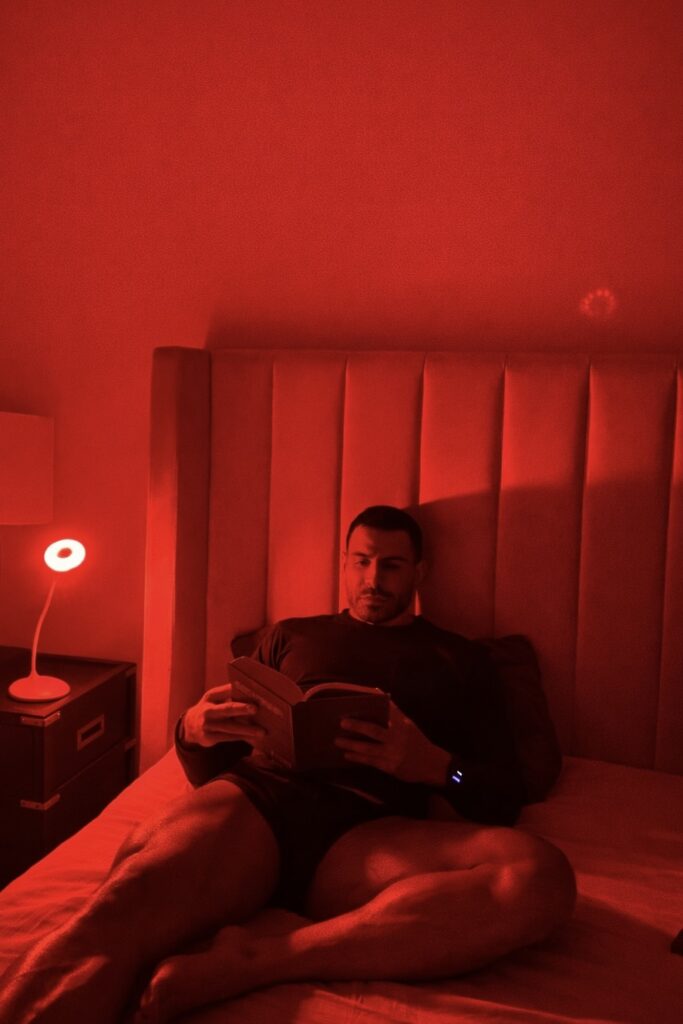
I love tech, but I try not to become overly reliant on it. I track my sleep, and I do think tools or wearables can be useful to give you a better understanding of where you’re at. However, ignoring how you feel in favour of the data can actually have the opposite effect and lead to things like orthosomnia (insomnia caused by tracking), or what Gary Brecka would describe as “analysis paralysis”, and that’s usually a sign to take a step back. I’ve tried everything from brainwave tracking to vagus nerve devices, but one thing that’s recently made a measurable impact for me is the Eight Sleep Pod. I’ll be honest, when I bought it, I wasn’t sure if it was just going to be another gimmick, and I really didn’t expect it to have the noticeable impact on my sleep that it has had. It is an investment, but when you think about how much of your life you spend in bed, it starts to make a lot more sense. I also wouldn’t be without my red light lamp, especially in the evening or when I’m travelling.
You share your experiences with the latest health and wellness hotels and spaces around the globe. How do you feel interior design and environments in hotels could be improved for optimal sleep?
Most hotels are designed for aesthetics, not for sleep. They might have things like blackout blinds and temperature control, but one thing that really drives me mad is light pollution. There’s always some kind of glowing panel or switch next to the bed, and it completely defeats the point. I’ve even got to the stage where I travel with black tape just to cover them. More hotels should think about circadian-friendly lighting that can shift in the evening. It’s not expensive, but it makes a real difference. I even travel with my own bulbs sometimes so I can control the warmth of the light. At the end of the day, it’s about creating a space that actually supports sleep, something that’s dark, cool, quiet and not overstimulating.
As someone who travels regularly, how does sleep change for you when you are jetlagged or dealing with broken sleep, and what do you do about it?
For me, it really starts during the travel process. As soon as I get on a flight, I’m thinking about the new time zone and trying to align with it as quickly as possible. I don’t eat on flights, and when I land, the first thing I do is get outside for light exposure so my body knows what time it is. I’ll also do some light movement, nothing intense, just enough to help reset things. I try to avoid napping, but if I really need one, I’ll keep it to 20 minutes max. The only time I’ll use something like melatonin is when I travel, and I’ll often have a hot shower before bed to help bring my body temperature down, especially as I’ve got used to my Eight Sleep and can’t exactly pack it with me. It’s all about giving your body the right signals at the right time.
You have vast experience with various aspects of the wellness industry, from health technology and wellness practices to clinics, supplements, and programmes. What do you think the big focus will be on next in terms of wellness trends?
Optimisation isn’t going anywhere, but I think the next shift is towards nervous system regulation. We live in a fast-paced, high-stimulation world, and more people are starting to realise that if your nervous system is constantly switched on, nothing else really works properly, whether that’s your sleep, recovery, or overall health. I also think community is becoming a big part of wellness. We’re already seeing it with things like sauna raves, coffee clubs, and the rise of wellness members’ spaces. People are crying out for connection, not just following clinical protocols. Alongside that, we’ll also see more biofeedback tools that give real-time data, helping people make more personalised decisions based on what’s actually working for them.
© Higher Self Experience